
Thinking like a Forest
On the art of uncivilisation
This spring a team of editors set out to create a collection of visual art that would act as a retrospective, a catalogue of the many genres our books have showcased since 2010: photography, illustration, graphic literature, calligraphy, painting, sculpture, land-based artworks, making, installation, ritual and performance. We wanted it to be a celebration of the artists who hold out for a certain way of being in this collapsing world: true to the transformative power of creativity, to the love of the Earth, and the material of life itself.
Civilisation holds us tightly in its unkind embrace, not only because it ‘controls the narrative’, but also because it manufactures the images that distract and misinform us, that keep us looking at the shiny surfaces we feel is our cultural reality. What happens when you uncivilise your gaze, shift your attention away from a perception of the world curated by Empire towards one co-created with all planetary beings who dwell in deep time? What happens when you follow the artists as they span dimensions across time and space, throw wild seeds into monocultures, move through the land, disturbing and liberating our vision?
What happens when you uncivilise your gaze, shift your attention away from a perception of the world curated by Empire?
Their work remembers the tracks the ancestors made in the beginning, how we need to walk this Earth in balance. And when the rational world becomes increasingly incoherent and closed, so it is that the artists come with their intelligence and their wit, their delicate brushstrokes, the rivermud under their fingernails, their masks and their surprise, to open the door and bring us home.
This book has the shape and dynamic of a tree. You step out into the canopy, along a walkway, to get a feel of the forest, what is at play on the edges of time. You follow the lines of certain branches: that take you back in time to the illuminated scripts of the parchment maker and the visionary, or down into the underbelly of civilisation where women fall into holes, subvert road signs, throw paint, walk across mined land, who listen to the stones. Bear witness to ruin and beauty.
In the heartwood, there is an archway of Sussex hazel that leads you towards the dismembered forests of British Columbia, recorded in brilliantly-coloured canvases mixed with the ashes of hemlock and cedar. Descending the trunk you encounter the axis for all the artists gathered here: the practices that grant them the rigour to reflect the world’s unravelling, to forge new connections and divergences for life – with ink, talisman, clouds, rainwater, rock, their own human bodies. The roots explore this emergent mycelial work: in collaborations with lichen, with microbes, with stalks of wheat, mountain slate and crow; in the studio which is a darkroom, and also a cliff, a river, a desk before a luminous window.
Finally, among the composting leaves of all our pasts, you discover the seeds: marks on a broken ostrich shell, the earliest known decorative art from Africa; the figure of John Berger beckoning us towards the stony dark where Paleolithic artists first began their illuminative work. A seed is a capsule of time, holding both ancestral knowledge and a vision for the future. Nurtured in the depths of ourselves, in the earth, it creates the tree, and then the forest.
Our path ends with a river, a water dragon in Australia.
Every step can reveal the prayer rug we walk upon, and every mark on the new map gives country back to itself.
It begins with an opening in a glade, a dance of invisible forms, and a fox-man in the English borderlands, moving downstream.
We follow his watery track…
Do join us for the online launch of Dark Mountain: Issue 28 on Tuesday 21st October, starting at 7:30pm (BST) to hear from some of the artists, editors and others who have contributed to this book from around the world.
A Zoom link will be sent two days before the event.
Hope to see you there!
Tickets are free but you will need to book a place on Eventbrite

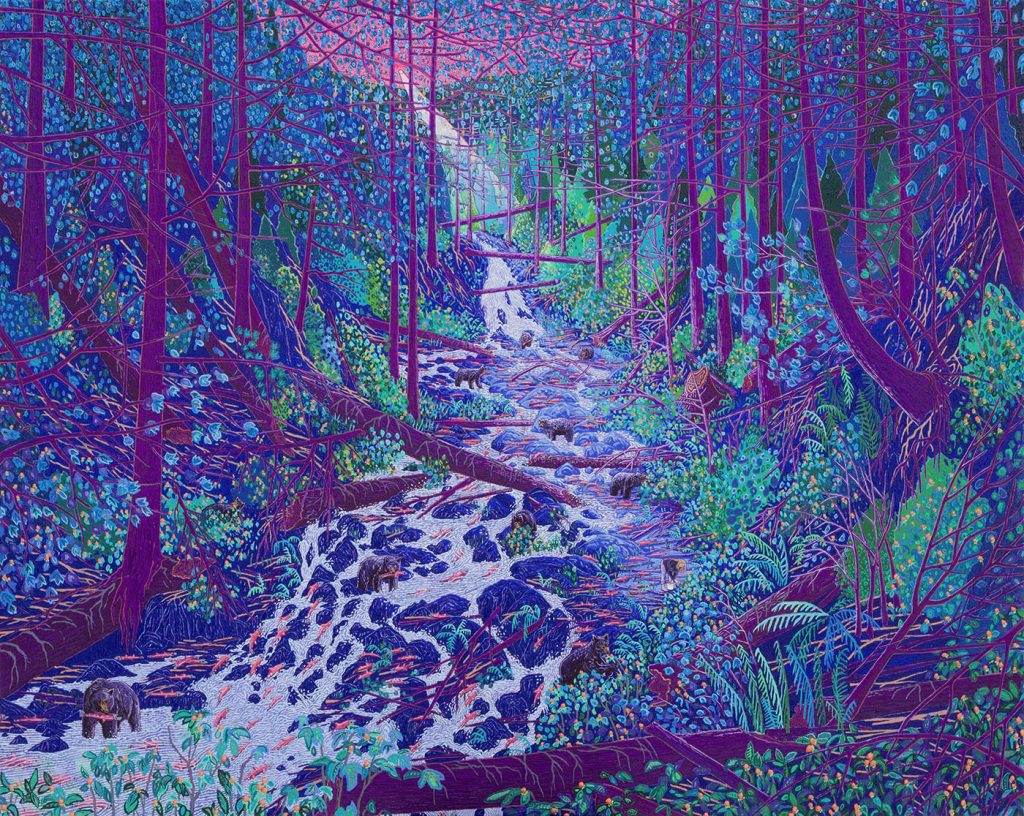
IMAGES: Kyle Scheurmann
(cover) Salmonberries
Oil on Linen
(Inside cover) Spring Studio
Oil on linen
I’ve watched infinitely large bodies of water transform under the full moon. Millions of litres sloshed around by a glowing orb in the sky. So if the moon can have that kind of effect on the water in the oceans, what’s it doing to the water in my body? The idea that ‘we are our surroundings’ has been in my work for a while. Figures in transitional spaces, about to plunge into a river or wade into the brush. Figures collecting or harvesting offerings from the forest in order to eat, drink or heal. These are painted metaphors for the divide between where we end and where nature begins.
Kyle Scheurmann is a painter and environmental activist, represented by Bau-Xi Gallery in Canada. His paintings depict climate crises as experienced during his ongoing research into industrial logging, wildfire and anthropogenic climate change in the remote wooded locations in which he lives and works.
Dark Mountain: Issue 28
Our Autumn 2025 special issue on Uncivilised Art celebrates the work and practice of artists in a collapsing yet still beautiful world
Read more


Hi, I am discovering you, after hearing for the first time about Rupert Read and his notion of thrutopianism (from the Kairos-London newsletter…), and will explore your archives. With our collective , we are convinced that the sea has a voice and we want to strengthen it. This has been the starting point of our transdisciplinary and multimedia arts project A Seat for the Sea. Finishing a performance installation now, ‘Beyond the dirt, in 5 selfies’, that will have its première on May 14 in Antwerp, Belgium.
Hello Raf, Thanks for getting in touch. You might like to look at our 26th issue, Dark Ocean, and the online section, Sea-change. With best wishes the Dark Mountain team