

My mind floats somewhere above the chaos, allowing my body to soften, moving back and forth like a frond of kelp.
I am part of this wave of energy.
I let my body get pushed down a little deeper
without pushing against the force this time.
Down
deeper
it is quiet and calm.
*
It’s never easy or comfortable getting ready to enter a cold ocean in the middle of winter, being pelted by sideways rain blown in from the sea on gale-force south-westerlies – the kind best described by the Irish phrase fearthainn a rachadh trí chlár darach, ‘rain that would go through a board of oak.’ But being comfortable with being uncomfortable is what creates a powerful sense of being and belonging – never clearer than in the wipeout, the moment you fall when surfing.
These wipeout moments are an invitation to soften into the force of the wave rather than resisting it, to be reshaped and revealed. To wipeout well requires a letting go of control, even while we are tossed off the wave and held under in an environment we can’t freely breathe in, our instincts screaming ‘escape’. When a hold-down gets really intense, I take myself elsewhere; into a blue mind state. First coined by marine biologist and author Wallace J Nichols in his book of the same name, ‘blue mind’ acts as the antidote to ‘red mind’, our stress response. Through a practice of visualisation, I have trained myself to relax the body and conserve oxygen by experiencing this inner state of calm.
*
The turbulence rips through my hair as I grip a stalk of slippery seaweed and allow my body to be moved like water.
Instead of feeling exhausted and beat-up,
I feel charged.
The wave action pulsing through me.
Time also feels different,
measured in the feeling of compression in the lungs and
jumpiness of my diaphragm contracting,
demanding I pull in fresh oxygen and
sending small convulsions through my body.
I tilt my head back and see the underwater storm clouds dissipate as a milky light penetrates the
churned
white
water.
I push off the reef, rising easily as my lungs expand once again and my ears gently pop
*

Something remarkable happens when we come into direct physical contact with saltwater. To be immersed in the sea is to feel transported to elsewhere, as if moving through a portal to another world – not only moving from the solidness of land to the fluidness of water, but also moving from the ‘head’ into the body. It’s this, I believe, that offers such healing potential – restoring lost connections, bringing us back home to ourselves, to inhabit not only our bodies more fully but the world. To be immersed in the Atlantic waters off the west coast of Ireland is to be held in the mix of sweet rust-coloured bog water and the golden-green iodine of kelp forests. It is to enter into the territory of the wild Atlantic salmon. Or at least it used to be, before the salmon stopped returning to their spawning rivers.
To be immersed in the Atlantic waters off the west coast of Ireland is to be held in the mix of sweet rust-coloured bog water and the golden-green iodine of kelp forests.
After a wave has broken, the burst bubbles release droplets that form a light salty mist suspended over the saltwater. This salty air is full of negative oxygen ions produced from water molecules with an extra molecule attached, believed to alter our biochemistry and soothe the nervous system. Negative ions are found everywhere in nature, but are especially concentrated around breaking waves and waterfalls. They are the silent antidote to a life lived indoors – a space most often awash with positive ions from electronic devices, air conditioning, artificial lighting, office furniture and cell phones.
*
My face breaks the surface. The first thing I notice is the hiss of the foamy water around me as trapped bubbles of air crackle and fizz on the surface.
At first, the saltiness stings my nose a little, before I feel my lungs expanding, inhaling more deeply, feeling my body fill with fresh oxygen.
Breaking free from the watery belly of the sea, all my senses are heightened. The water tastes sweet from the river flowing into the sea, colouring it golden-brown like tea, and it feels much colder. For a moment, all the world is sky and water. I quickly check over my shoulder for another wave about to land on me, but the ocean is calm.
Relief washes over me, mixed with a momentary and strange sense of separation from my full-body immersion in the
watery
world
below.
*
Born to pioneering surfing parents on a new moon, during winter storms, and named after a wave with its roots in the Irish for fish, Iascaigh, it is little wonder I took to surfing from the time I could walk. There are so many different dimensions to my encounter with the sea, influenced by temporal cycles of change – tidal, lunar, weather, seasonal, menstrual, life cycle, from maiden to motherhood. To be a surfer is to be in conversation with the personal elements of a place, of a wave creating its own narrative.
The movement and touch of water ignites something in the body, triggering a whole cascade of changes in our emotions, feelings and how we sense the world around us
To surf is to actively participate with the more-than-human, living world – the ocean that breathes us all into existence. The sea shapes our experiences and feelings through its own powerful, non-human agency. This shaping effect is what creates a sense of becoming. To surf is at once to be both fully engaged and to let go. We surrender our sense of groundedness and solidness to floating free and being at the mercy of untameable, changeable currents, flows and more-than-human environments. The movement and touch of water and waves ignites something in the body, triggering a whole cascade of changes in our emotions, feelings and how we sense the world around us. It’s why water can be such a potent way to reconnect and come back home to our bodies after a traumatising experience.

Perhaps even more than wave-riding, wipeouts can offer a feeling of the aliveness and intelligence of water as our own flesh and blood merges with the aliveness and intelligence of water.
It’s this quality of immersion that I tapped into for the birth of my twins.
*
We begin life immersed in the amnion, in the saltwater of the womb. The water protecting us, absorbing shocks, helping us grow, shaping our movement, supporting everything we will become. I never realized how much my relationship with water would change when I became pregnant. As a lifelong surfer, my body is my ocean-going vessel and throughout my pregnancy I craved contact with saltwater but, for the first time in my life, if the water was too rough or choppy, I felt sea-sick. Nor could I trust my breath or my lungs when held under a wave, as my cardiovascular system was already working in overdrive, circulating over twice as much blood to support the new life growing inside me.
After 25 weeks, when it felt too uncomfortable to surf, I discovered the profound benefits of going for regular sea dips in nothing but my bare skin. These immersions gently and gradually built up on my body like the accretion of an oyster shell. I felt a growing familiarity and understanding of both my body and the body of water I was entering. I marvelled at the sensation of lightness and the connection with these two other bodies of water growing in my womb.
The ocean followed me into the hospital. As the trolley was pushed in a hurry through the swinging double doors and under the bright lights of the operating room, I crossed the threshold from shore to sea, dropping into the soft fluidity of my animal being before it was cut open. I felt the rush of water move up and over my body, sinking below the surface as the anaesthetist counted down from 10 – 9 – …

Held in gentle sway by the womb of the world, the silky touch of rippling kelp, the dazzling, dappled light of the sun through the movement of water… I knew the moment you were birthed, when you were no longer in my womb. I swam in the sea floating free in the water and you were there with me. Three of us swirling and whirling gently like seals, bathed in oceanic light. A feeling of joy, the realisation you had safely arrived. Born at the time of year the sea pinks burst out from the cracks in the rocks: Ameria maritima, my favourite flower, the embodiment of resilience – most at home in the liminality of the intertidal zone, capable of surviving immersion in saltwater and able to extract water from sea spray.
It comes slowly settling onto the seabed of my being, through a haze of all night feeds, a daze of sleep deprivation, the throbbing of sore nipples and heady wash of oxytocin: How close we came. The loss of all I desired for our birth. The power of activating my blue mind at the moment of emergency. The beauty of softening into the ineffable instead of pushing through. Feeling and drawing upon the safety and support of the ocean that I carried within myself.
A recent medical study suggested that regular cold water immersion could lead to a reduction in difficulties during labour and negative birth outcomes. Perhaps cold water, combined with the novelty associated with stimuli of an ever-changing sea – breaking waves, moving currents, changing weather fronts – created a low-dose stress response in my body that helped build resilience and adaptive capacity during a very challenging birth and recovery from emergency surgery. At the moment of crisis, I was able to access a profound experience of trust in my body and in the power of birth, whatever shape it took. A trust born from the build up of so many moments of encounter in the sea. Caught in the turbulence of the space between life and death, I realised my body was preparing for an intense ‘hold down.’ Tapping into my blue mind, I relived cherished memories of being held by the ocean while I held my twin babies in an inner ocean.
*
Months later, in a place most familiar to me where land and water meet, I find myself feeling completely unfamiliar in this new, scarred, stretched and torn skin, preparing for my first immersion as a new mother. Standing on the tideline feels like a borderland: the border between my skin and the sea; the edge of what is known and unknown; at the boundary of control and surrender. Borderlands, it has been written, can be places of wounding and bleeding, and yet the scars signify healing.
It is sunset and I have come seeking what is known as a tearman in Gaelic – a place of sanctuary on or near a borderland. The sky is ablaze above the dark blue silhouette of the sea cliffs of Slieve League with the sun slowly swinging back to its winter haunt once again. My other senses come rushing into focus as I close my eyes. Sounds became more vivid, almost like hearing the world in colour: the deep blue of a hollow wave rumbling, the golden-green of a surging wave crashing onto the sand, the amber-yellow of the fizzing sea-foam.
*

Returning to the sea as a new mother has allowed me to begin to welcome and inhabit my forever-changed bodymind in a new way – seeking joy, presence, play and connection over challenge, risk-taking and fear as I navigate the postnatal shift from ‘me’ to ‘we’. There is a beautiful Gaelic phrase, fighte fuaighte, which Irish philosopher John O’Donohue described as ‘woven into and through each other’. By this, he meant how in the Celtic worldview there was no separation of the senses, self, nature or, indeed, between the eternal and living worlds. This journey of becoming a mother could be framed in a similar way. Immersion is never a one-way act. When a body is immersed in water, the water knows. It responds and is forever changed.
It is the same when a mother’s ‘body of water’ is home to another living body. Cells are exchanged between the baby and the mother, cells that can remain in the mother’s body long after birth. Maternal cells remain in the child too. Lucy Jones writes about microchimerism in her book Matresence, describing how it creates a lasting connection and blurs the meaning of the individual self. How we all enter the world teaches us how it is to be part of another being.
Motherhood is a profound immersion that reveals a more bodily way of knowing; one that can awaken a deeper understanding of the potent, intimate, sensual and vulnerable nature of our relationship with the world
Like submerging ourselves in water, motherhood is a profound immersion that reveals a more bodily way of knowing; one that can awaken a deeper understanding of the potent, intimate, sensual and vulnerable nature of our relationship with the world we are born into. When we immerse our bodies in water, it is a powerful reminder of our interdependence with the source of all life. Through regular immersion, a blue attunement develops – an awareness and responsiveness to the body of water we are interacting with; a deep form of listening. From this can awaken a wish for a more beautiful ocean in which all our children can immerse themselves.
Motherhood has reinforced for me the need to dive deep, to encourage the restoration of water and to honour and celebrate its rare and precious life-giving force. My hope is that we will come to understand our interdependence with watery places and beings and to sense and feel the aliveness of these connections – to feel that we, too, are water.
*
The high tide water presses gently around me, warmed by the sun’s heat seeping out from rock and sand. Under a sliver of a crescent moon hovering just above the oceanic horizon, I hold my head up and gently stroke out into the shimmering liquid gold, on fire. Feeling the roar of life in the stillness. I could keep swimming and swimming into the expanse forever, becoming ocean, sky, whole and held, floating free.
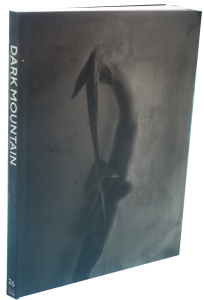
Dark Mountain: Issue 26 – Dark Ocean
Our Autumn 2024 issue is a full-colour exploration of the world's oceans in an era of collapse – in narrative, verse, art and photography.
Read more


