

Frans Snyders was a Flemish painter who lived from 1579 until 1657. He was one of the earliest specialist ‘animaliers’ or expert painters of animals and he is known for including many new species of animals in his works. He painted pronkstillevens, or ‘sumptuous’ still lifes, which are meant to depict the diversity and abundance of the natural world.
Dear Frans Snyders,
You don’t know me, but I’ve seen your paintings, and they make me think about home. That might seem strange considering you were painting in Antwerp in the 1600s, and I’m a student from Florida in the year 2023. I’m writing this on the 26th November, a few weeks after your 444th birthday. My birthday was a few weeks ago, too. So we’re both Scorpios.
Last year I moved to Vienna, and I spent many lonely days wandering around the Kunsthistorisches Museum. Your painting, The Fish Market, stopped me in my tracks. It was so big that it took up the entire wall. People say the Flemish invented oil painting, but really you just popularised it in Europe. The oldest known oil paintings were created by Buddhist monks in Afghanistan in the 7th century. They used oil from walnuts or poppies to mix their pigments from clay. You probably used flaxseed oil mixed with eggs. Your canvas was probably made of tightly woven hemp, stretched over wood. So, on the material level, your painting is made of seeds and trees and clay and the embryos of birds. Your painting is a still life, and it is made of organisms, rendered still. When I looked at your painting, I was looking at the bodies of would-be baby plants and animals, squished and swirled together, dried out, woven and stretched. Your painting is an amalgamation of the once-alive. It is a still life.
When I saw The Fish Market, something about it made me stop. It was full of species that I didn’t recognise. There was a giant spiky crab, a long-nosed shark, and at least two kinds of stingrays. They were bigger than the fish I knew, with strange fins and unexpected colouring. Some I wasn’t sure how to place. Were they eels? Sea snakes? Was that an obsidian lobster lurking in the shadows? They looked alien to me, from another world.

Frans, I grew up by the ocean, but I didn’t recognise these fish. I don’t know if you painted them to scale or took creative liberties or what. But I assume these were the organisms of your ocean, of your time. There are so many different kinds! I appreciate that they are the focus of the painting, not the humans on either side. I appreciate that you painted them all together, like an awkward family portrait. I appreciate that none of them are alone. That they are together in their dying. I appreciate that you made them visible. They are visible, and they are dying.
For you, in the 1600s, this painting represented abundance. I understand it is a pronkstillevens, a ‘sumptuous’ still life, meant to celebrate the treasures of the natural world. You painted them like treasures, flashing silver, bleeding ruby red. Eels so wriggly you could wrap them around your wrist like a bracelet. You painted this fish market several times, didn’t you? Perhaps there were too many interesting organisms to fit in a single painting. In your time, the ocean was teeming with life. Teeming! A word that we don’t use as often, these days. Teeming, swarming, flocking. Language of abundance. Language that describes the movements, practices and becoming of the more-than-human world. Of what Indigenous scholars call animal nations or relatives. Of what feminist scholars call kin.
The Fish Market hung in a gallery beside paintings of famous battles, war scenes. Piles of bodies pressed together. Piles of beings, nations, kin. It made me think of the buffalo, that one photograph. White settlers shot them for fun, for sport, for genocide, then heaped them together into piles as tall as buildings. Abundance. It is not what it used to be. This painting represented something different for you. We are poorer now. I’m afraid you wouldn’t have very much to paint.
Frans, you are one of the earliest known animaliers, or expert painters of animals, but how much do you know about the animals in this painting? Did you know lobsters never stop growing, that they taste with their feet? Did you know otters will wrap themselves in seaweed to form a raft, so they won’t drift away from each other? They have a secret pouch under their arm to keep their favourite rock, which they use to break open shells. Did you know that dolphins name their babies with special sounds and sing to them while they’re still in the womb?
As a master of the still life, you seem to be more interested in these animals in their stillness. But what is a still life? In your time, there was so much life. Communities overflowing in their swimming and hunting and playing and migrating. They brought with them choruses of sounds, singing, rhythms keeping time of the day and night, and spectrums of colours shimmering and flashing through the water, across the sky, over fields and in the canopies of forests. They built between them intricate systems for living, reefs and nests and burrows. They textured the world with movement, sounds, colours and smells, structures, patterns and practices. There was so much life that you had to ask it to stand still, just to capture how beautiful it was. I can understand why you became a painter. There was so much to paint. What is a still life, now? What is still alive?
I can understand why you became a painter. There was so much to paint. What is a still life, now? What is still alive?
Sometimes I wonder if we collect colourful things, if we hoard bright knick-knacks and rainbow stickers and nest our homes in twinkly lights, and dress in patterned sweaters and neon beanie caps, and keep our earphones in listening to music all the time, because some part of us misses the feeling of being surrounded, being enveloped, by the texture and density of all that life. All those nations, our kin, those billions of beings who are not here anymore.
I noticed a lot of artists in your time liked to paint hell, and even your hell was biodiverse! All those winged demons and goblins and spiky, throated monsters crammed into a single painting. Your hell was brimming, roiling. Ours is empty, and silent.
As I walked through the rest of the museum, your painting kept calling me back. I had to look at it more closely. I had not looked so closely in a while. Looking closely is difficult these days. It’s hard to slow down, to sit still, to be in a body.
The faces of the fish! That’s what was bothering me. You painted them with so much emotion. Their eyes were sad, wise, like they knew what was coming. Today, scientists tell us that fish have memories and emotions. They play and they fear and they love. They can even do arithmetic! Did you sense the pain and fear these creatures felt as you painted them? Is that why you crafted their faces so delicately?
Frans, I wanted to inform you that people are throwing soup at paintings now, as a form of protest. Don’t worry, yours is probably safe. They say there’s no art on a dead planet, and I think you would agree. These days, museums feel less like a celebration of human mastery and more like a reliquary. Somewhere we will go to remember who used to be here.
But it is one thing to look at a painting, and another thing to exist alongside other creatures. To witness their becoming as they witness yours. To be permeable and porous in relation to them. I heard that all the organisms that evolved to move from the ocean to the land carry the vestiges of salt in their veins, including humans. That’s why we cry salty tears and bleed salty blood. Our skeletons are calcium, the same stuff as seashells.
Frans, I grew up by the water. When we were little, my brother and I used to run around the beach at night with flashlights, chasing crabs. I remember the crabs, I remember how tiny they felt perched on the tip of my finger. They tried to pinch me, but their claws were too soft. We used to watch periwinkles, a million colours, diving, burrowing into the sand with each crash of a wave, and I wanted to ask them how they knew when the wave was coming. There used to be signs that said SHUFFLE YOUR FEET for stingrays. I remember being seven years old in swimming goggles, shuffling and whispering, hello stingray, I am here! The last time I visited home, there weren’t any crab holes, and someone took the signs down. No need for shuffling anymore. All these lost rhythms of co-existing. I’m trying to remember them. So much of what makes the world the world is fleeting, emergent, over in an instant. I don’t have pictures of it. I don’t have paintings. I will have to remember.
I heard that 150 species go extinct every day; I also heard 24. I heard 21 species went extinct in the US in 2022. I heard most species are of low concern for extinction. I heard animal populations plummeted 70% in the last 50 years. I heard focusing on extinction distracts us from the bio-annihilation of animal populations that is happening right now, that has been happening for decades. I heard up to one million species are at risk. I heard other numbers, too. Numbers are hard to trust, harder to picture. To picture this, I think we need a still life. Imagine if we piled up all the organisms we’ve lost the way you did in this painting. It would be a still life the size of a nation. The size of a world. Could you paint it? Now, I know this isn’t your thing, but imagine if all these organisms were alive, again. Imagine trying to paint them in their flocking and swarming and celebrating. Imagine celebrating with them. Imagine asking them to be still, for a moment. Imagine them still alive.
Frans, I’m not trying to pick on you. I know you just wanted to paint some fish. But you were painting around the same time that the Dutch government was forming the Dutch East India company, the world’s first multinational corporation, which, like most of the corporations that came after it, would grow rich off the enslavement of Indigenous communities and the plunder of their Lands. So, if you get this letter, here’s what you should do.
Use your art to cultivate reverence for the place and the beings that made you.
Share your art with everyone in Antwerp, and teach them about the more-than-human beings who make it possible. Introduce these creatures as your collaborators, your beloveds. Use your art to cultivate reverence for the place and the beings that made you.
Next, request an audience with the king. You’re famous enough to do that, right? Invite all the artists you know to come along. Tell them to bring one painting each. If you’re feeling dramatic, bring some soup with you. During your audience, unveil the paintings for the king and let him appreciate them for a moment. Then tell him THERE’S NO ART ON A DEAD PLANET. Warn him the treasures will run out. Remind him that to paint you need flax and hemp and clay and lobsters and otters and eels. Tell him that colonialism and capitalism will literally dissolve creatures in their shells. Refuse to leave until he understands the concepts of reciprocity and kinship. Teach him to love the ocean like his own blood. Most importantly, teach him to love the fish.
Sincerely,
A student from the year 2023
IMAGE:
John Weeden
‘Dead Catch’
Gouache on cardboard
‘Dead Catch’ refers to overfishing and the demise of biodiversity. Metaphorically it also refers to our mental fishing which increasingly brings up distorted, deranged ideas, devoid of common sense – a dead catch.
John Weeden studied art in New York and France and lives in northern Spain. Abstract figures dominate his work, working through themes of community, storytelling and identity.
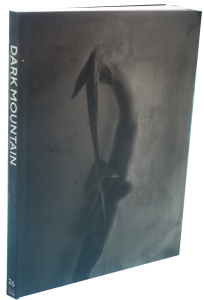
Dark Mountain: Issue 26 – Dark Ocean
Our Autumn 2024 issue is a full-colour exploration of the world's oceans in an era of collapse – in narrative, verse, art and photography.
Read more


