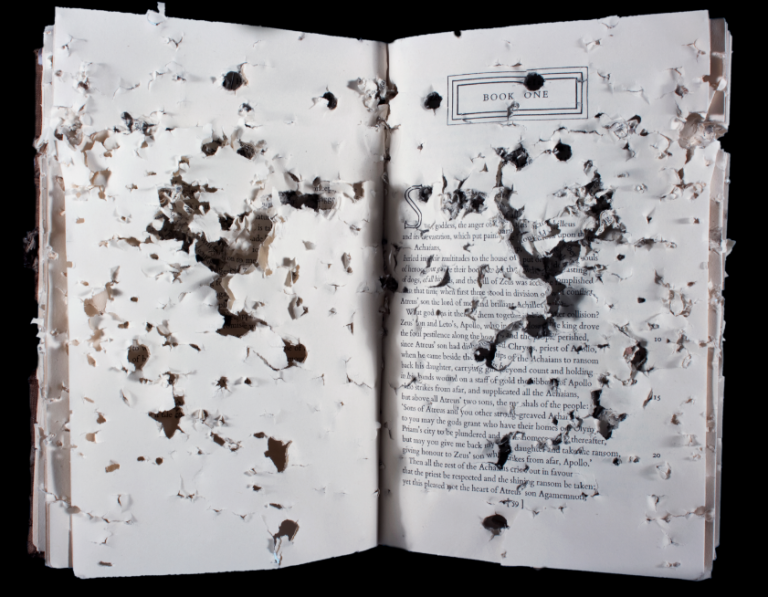
Ecogodliness
– Felicia Zamora
Antigone
from the sentry
done! And that was how I found her, this mad little lass
in a stungun stupor, slumped on her shovel under the
punchdrunk sun. God she must’ve been dogtired,
her spine buckling under the grit and the
grime, her whole body quivering beyond its
usual borders. And she did summat in the pit,
bent down and drew summat in the dust she’d
flytipped from an urn. I was straining to see
just what the hell she was up to, crouching
in the clammy cloudlight of a stell and
under strict instructions to keep stum. But
I suppose you heard the gossip up the ginnel, no?
it doesn’t bear repeating, does it? –
what her fatha did and did to whom, but it was
you, the sorry old bastard fingerwagging
from sawdust estates and shambolic newbuilds,
you did this Creon. Forbidding a funeral
was daft enough, but what possessed you
to abandon the poor sod in the underpass?
Christ knows. I mean dragging it up under
a drystone wall, where the terraces thin into
fields and fenceposts, could you blame her?
There’s summat I haven’t mentioned mate.
You see, for reasons best known to herself
she did a runner. And further up from us
in the fells, summat seemed displeased –
in the binoculars, the reservoir was wrinkling
its nose, the sluicewater toughening in the
tortuous wind. I stumbled down fresh mud
in the immense distances of the moors to
where his body shimmered supine on the
little stones. So there he was, naked in the
hot wind, with goosebumped skin as damp
as old plaster, with a smattering of dust
insinuating the darkness and the
dieback. I remembered my orders Creon,
but I knew him when he was a bairn, and
I really doubt you could brush the dust off
a dead man’s face either. Think of it as
muscling in on memories that aren’t yours.
So I just sat with him, until I was bored
of being bored, counting up the cairns
(I remember at least seven of the sods.)
I was about to be off, haggling with the
horizon, when I heard this screeching –
hell’s teeth! I was picturing our Ani
hurtling from a flyblown heath, seeing
some random radgie gawping at her
kid brother’s burial. I didn’t see nowt,
and that slapped some sense into me.
Just the remnants of a pine plantation
that had been untended for decades, and
there was a ruined peatcutter’s hut with its
squadrons of curlews nosediving like Stukas.
Yep. I was about to be off, but by Christ didn’t I
have enough bother before that howling in the wind?
– Finn Haunch
IMAGE
Maria Renée
Desert Emergence
Ink on Bristol board
The palo verde beetle of the Sonoran Desert tells their story of becoming, having emerged after a three-year larval period beneath the soil.
Early summer is the best time to be underground, to grip the earth, to be enclosed. We must be held before becoming part of the sky. We must be tightly packed particles, with time to nourish our bodies before we fly. There is no sudden transition between below and above –the tree roots are a bridge. We get to know the light as it was digested by the palo verde trees, having absorbed the sun with their verdant bark. In this way, we already sense what’s above led by impulses of hunger, while patiently living below. They generously feed us. We tend to the old and weak, transferring their energy into our bodies tasked with carrying that light into new shapes. Who might, then, eat our bodies in the crowded summer, furthering the thread of aliveness in a form that may have feathers or padded feet?
We wait for the humid air to put pressure on the soil; an arrival, soon, of rain. A generation breaks through into the sticky July dusk, into the thick heat of approaching night. It’s brighter than we’ve known it, but we carry the balance of light, having wriggled in the dark for three years, in our bellies. Our wings, like the sound of thunder; foreshadow the season to come. We find one another.
Let me tell you about the process of change, from our ancestry of knowledge. Let me tell you, that it isn’t easy to become something you have not yet been. All you have is the moment when you must become it, and the trust that millions before you have found their way. There is no one way to rearrange oneself but I can tell you that the body knows how to fall apart and become whole again. The body knows how to metabolise the past and become a being who fits into the future.
There is a patience that only this type of pupation requires: a surrender to cracking open, unravelling, engaging all one’s faith in the process while completely disappearing and meeting yourself anew. The shedding of a soft body in hard substrate and the first stretch of a hard body in soft air. No, it isn’t easy, but it must be done. The transition into a more solid form delivers new wonders – the delight of flying, the feel of the movement of air, the possibility of courtship.
And so we go, having changed. We go up into the turning of the evening, humming, and searching. We know just what to do.
Maria Renée is an artist, writer and ecological grief-worker who explores animism, connection, and dreaming. Everything she creates is in collaboration with the natural world. She currently resides in her birthplace, the Sonoran Desert, where the coyotes sing and nighthawks swoop at dusk. maria-renee.com
Dark Mountain: Issue 27
Our spring 2025 issue is a hardback collection revolving around bodies, human and creaturely, plant and mineral, in an era of planetary breakdown.
Read more
FOOTOTES
1. Mei-Mei Berssenbrugge, A Treatise On Stars, Pg.67