
EDITORIAL
The End of the World as We Know It
It’s on us, said the librarian in the local library. We all lit the fire.
Since 2009, our Dark Mountain anthologies have tracked these burned territories of extinction and loss: they have held the testimonies of writers and artists, not only to fire, to drought, to flood, to the disappearance of creatures and cultures, but also to how it feels in our hearts to bear witness to the collapse of the world as we once knew it, of a path we thought would always be there for us. To how we might remember those original paths, and start restoring them.
Now, in 2026, we have made the decision to bring this stage of the Dark Mountain Project to a close. Along with the other collapses – environmental, political – has come an increasingly precarious financial climate, and the rising costs of producing and distributing high-quality books have become too high. The books have always been at the heart of what we do, so we have made this decision with no small amount of sorrow. But Dark Mountain has always questioned the imperative of endless growth, and the reality of endings has been core to our work from the start. This, then, will be the last of our biannual issues.
For the final book in this 16-year series, we reached out to some of the people who have written for, edited and shaped Dark Mountain over the years, inviting them to send work on the theme of ‘endings’. Appropriately, our last book is the first to have endpapers, created from the astonishing blue of foraged vivianite. Between those endpapers are meditations on what it means for things to end: from a story about a hospice nurse and a requiem for the IPCC Report to the writings of the last scribe, entombed among his books, hearing the siren voices of the barbarians outside the walls.
The image of the ‘dark mountain’, taken from a Robinson Jeffers poem, has both challenged and grounded us for the decade and a half of our existence. It’s no surprise, then, that several of these pieces take us up (as well as down and inside) mountains: from a starlit vigil in the Scottish Highlands to the wilderness of the Yosemite Valley to the smoke rising from wildfires in supposedly ‘green’ northern Spain. But the symbolic descent of mountains also leads us into the woods, into possibilities of regeneration and fertility, where strange forms loom in the dusk, the Green Man shows his foliate face and an ancient prophecy of restoration emerges from the heart of a tree.
Though Dark Mountain has never been an activist publication, many of those who have written for us have been, and are, activists, putting their bodies on the line to stop, or at least slow, the ravages of extractive capitalism. Their contributions to this book take us from Aotearoa New Zealand’s biggest coal mine to a climate camp occupying Cornwall’s seat of government, from traumas created by nuclear technology and weapons of mass destruction to the ways that trauma is processed in the human body. As always in our books, the more-than-human has a presence here too: a speaking glacier, a trusting toad, galloping horses, millions of hornets, fig leaves, hawks, grizzly bears, California gulls and Roosevelt elks.
A speaking glacier, a trusting toad, galloping horses, millions of hornets, fig leaves, hawks, grizzly bears, California gulls and Roosevelt elks.
‘Join us. We leave at dawn’, the Uncivilisation manifesto invited, and Dark Mountain has always taken the form of a journey. A canoe voyage in a lightning storm through the arid lands of Montana asks what traces we’ll leave behind, and a life on the road leads to a glimpse of Andromeda – the only other galaxy visible from our planet with the naked eye – and opens the door to the vast unknown that lies ahead. The image of a grass rope, woven by many hands, leads across an expanse of dunes to the next thread in our journey…

Before you head out on this final trail, we would like to say a heartfelt thank you to everyone who has accompanied this amazing procession to this point: writers, artists, poets, performers, storytellers, producers, editors, proofreaders, book packers, administrators, record keepers and the others without whom none of it would have been possible. And of course to our readers and subscribers all around the world – Mountaineers, Navigators, Ridgewalkers, Alpinists and Provisioners – for supporting us so generously every step of the way. We would like to say a special thank you to Christian Brett at Bracketpress, who has typeset and designed every Dark Mountain book so beautifully from the manifesto onwards (you can see the roll call of these books’ themes on page 221).
No one knows what new paths might emerge from the voyage we’ve all been on, or what seeds might grow from the falling of a tree. The burned heathland in Suffolk looks like a scorched desert now, and its recovery will take many years, but plants and trees will grow there again, and birds and animals will return. Even after such an inferno, the end is not the end.
Meanwhile, from all of us at the Dark Mountain Project: we wish you luck and happiness for the journeys ahead. Thank you so much for travelling with us.
The Dark Mountain Project will continue to publish writing and art in our online Substack edition, and to host the archive and bookstore on the website. You can continue to support our work by becoming a subscriber to the project and/or Substack
CHARLOTTE DU CANN
Andromeda
Bisbee, Arizona 1994: Mark and I have just arrived in this high desert border town. As we wait to hitch a lift to the store, a blue van stops and a smiling man at the wheel asks us where we would like to go. It is an encounter that would change our lives. When the copper mines shut down in the 1970s, the deserted town became an artist and poets’ citadel. It had attracted seekers dropping out of the system for years. We were the last in a long line.
The driver was Alex Hay, who was once a well-known artist in New York, a sculptor and dancer who had worked with Merce Cunningham and Robert Rauschenberg. He liked to challenge his audience. One of his performances consisted of reading the entire contents of the Manhattan telephone directory. ‘Did people stay?’ we asked him. ‘No,’ he laughed, ’not for the whole time’. One day he got in his blue van and never went back. For ten years, he criss-crossed America, until he arrived in Bisbee where he began a life-project of repairing and renovating a 32-room miners’ hotel. His studio below the hotel was like a monk’s cell, a bare airy room, with his craft tools immaculately set along on the wall. Decades later when Alex turned 90, his gallery hosted a retrospective of his work, including several of his huge intensely studied coats of four of the cats that lived in and out of the kitchen upstairs.
Like Alex, I had left a fashionable city life behind, my journalist eyes trained to recognise the shiny glamorous things people desired, as well as the skill of their makers. We had already been on the road for three years in search of a liberation from that acquisitive world. What I had not appreciated until I met him (and Carmen and Peter who also lived in the hotel), was that those who had deliberately relinquished their lives in this way perceived the world differently. Their practice was not about seeking fame or fortune, but about collaborating with the Earth. They worked for the spirit of things, as memory makers and medicine walkers. I learned it was the attention you paid to the world that mattered. The shift from pursuing ambition in a city to this bare room with its woodstove and rolled canvasses taught me everything about living a creative life. This is the way you go, this is where you end up. Sometimes. I would see Alex watching the ravens jump and dance on the railings outside his studio, and laughing.
One night, standing in the street, he pointed up into the huge starry desert sky. ‘You see that blue space up there?’, he said. We strained our gaze upwards and followed his finger to a fuzzy area that didn’t seem to stay still. ‘That’s Andromeda. It’s another galaxy altogether.’
I once took a class in the literature of the 12th-century Renaissance that flowered in the religious and secular culture of southern France. I remember almost nothing about it now, except for one detail: when the troubadour poets brought their songs of chivalric love and beauty to the outside world, no one understood what they were talking about. It was like a foreign language that bore no relevance to their known universe, as if the singers had arrived from another galaxy. But some heard the songs anyway and were softened in a place they felt, even though they had never before spoken of it. The introduction of courtly love swerved their attention from the warrior epic toward the lyric and romantic. And you could argue that European culture, both high and low, has been holding the tension between the two ever since.
Sometimes you can glimpse the moment when another language enters the culture and begins to swerve it beyond its current trajectory. Sometimes it is not made of words.
It was that language I recognised when I became art editor for Dark Mountain. Among the submissions for Issue 5 I found a painting of red deer among birch trees that startled me. Not because of its shape, that archaic form that startles you awake in the woods, but because of its materials: it was made of a (road-killed) doe’s hide and painted with the smoke of the trees’ bark. A physical Earth language of hand and eye. And though I brought a useful experience of working with images to these books, years of poring over magazine lightboxes and layouts, I also brought an encounter with artists who lived and worked on the edge of the Roman Empire (as one of them described it). People creating songs – not to remote women, or the glory of the battlefield, but to a beloved, beleaguered Earth. Artists whose work takes us towards a multidimensional perception of the planet that is almost impossible to describe. Something that shines through our seemingly intractable world, that has the scent of beeswax, or snow, the colour of turmeric. That startles you in the bush.
Each spring Alex and Carmen would go to witness the deer dance in the Yaqui heartlands: where all night a man dressed as a ceremonial deer dances for the people and the land. All cultures, when they put deer antlers on their heads, indicate that they are accessing the fleet worlds of spirit, connecting human beings with the correct way of walking the Earth. For the Yaqui the deer is an animal from the many-layered Otherworld who comes into this phenomenal world to bring life to the people: who lives, dies, leaves his body for food, and then returns. He is showing us how we come into this life to give sustenance for life itself. You are an enchanted flower wilderness world, sing the deer men. You lie with see-through freshness. The dance opens the door to the worlds we don’t ordinarily see but need to, in order to keep this one in balance.
The dance opens the door to the worlds we don’t ordinarily see but need to, in order to keep this one in balance.
For this final ‘wild gallery’, I wanted to show the work of people who follow the track of the deer, speaking in a way we had always spoken when we used to listen to the dead and our ancestors, the creatures and the trees. The Earth speaks in an uncivilised tongue: the artist finds the syntax in the shape of a glacier, or a falling fig leaf; a man walks to the river and buries a blackbird in a shroud; a woman honours her Indigenous grandmothers standing among prairie grasses; another builds an ark of remembrance in a rewilded field, or slowly grinds blue pigment out of a river stone. Some of us, wordsmiths, have struggled with how to speak this language, and awoken with prophecies on our tongues, or become more kin with horses.
The artist in the mountains sits by the winter stove, mends her walking socks, and sees the cosmos. Isn’t that what we all want to see? In the ordinariness of life, eternity woven in the fabric of time? A world of see-through freshness. Sometimes you need a person to speak to you in that language, to stand beside them, as they dig a hole, or darn one, as they put a grass rope woven in the Atlas Mountains, by the Cornish sea, into your hands, an animal mask on your head: to let yourself be shifted and remember. Sometimes you need to be shown a blue door in the sky, you never realised existed. To know that door is open. That Andromeda is always there.
IMAGES
William Bock
Jersey Green Rope
Jersey shore
The Green Rope Project uses the act of twisting a sugán rope (an Irish straw rope) to bring people together. It draws from our ancient heritage of resourcefulness and creativity in challenging times. The Green Rope is a social sculpture created in meitheal (Irish for shared labour) which becomes a physical record of the time spent working together.
William Bock is a multidisciplinary artist based in Ireland producing innovative projects for and about diverse communities and the environments they inhabit. His practice delves into the complex experiences of living between cultures, landscapes and identities, using a combination of collaborative filmmaking, photography, field recording, performance and installatio
Angela Cockayne
Final Voyage
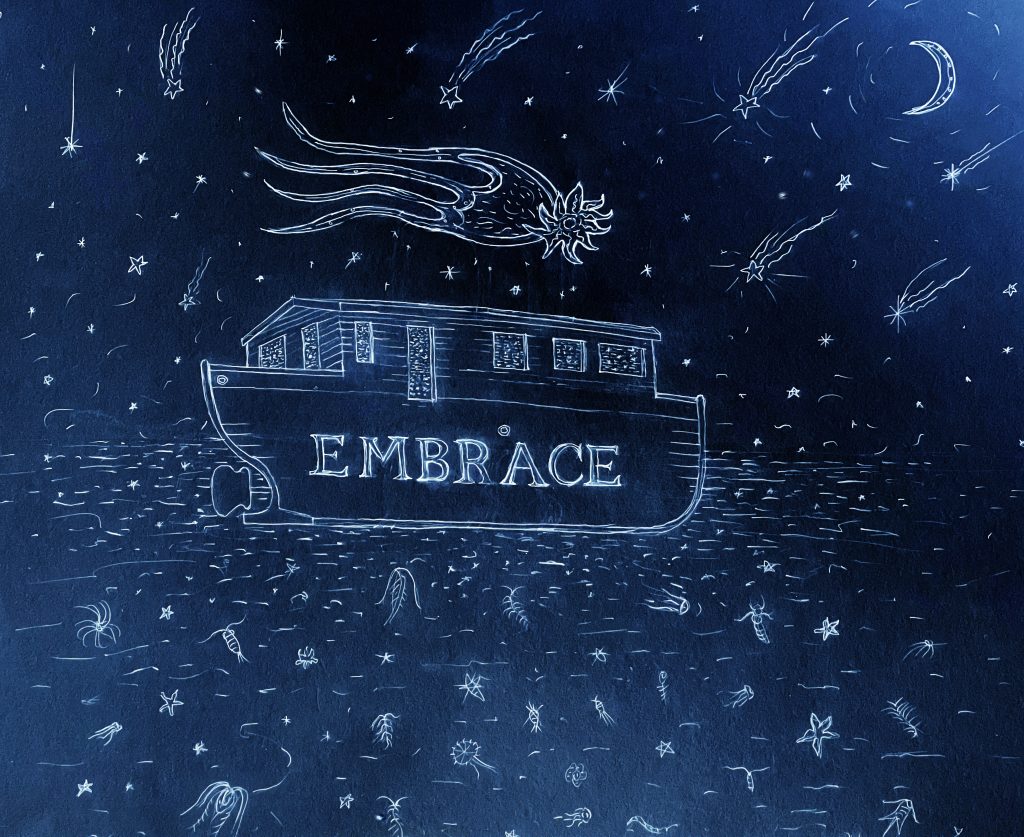
Blueprint
Ark Embrace was set up as an environmental cabinet of curiosity. This blueprint (one of many) was from her final voyage up the Helford River, Cornwall under the Milky Way in a sea of phosphorescence. Now the meadow in which she nestles has itself become the wunderkammer, a nature regeneration project – from bowling-green smooth grass, grazed by sheep, to a bejewelled garden of delight bursting with wildlife in just eight years.
Working as an artist and curator Angela Cockayne uses found objects from the environment to create artworks that express our dominion over the natural world and our relationship with the ocean and its mythologies. Publications include Embrace, Radical Fauna Provenance and Dominion co-authored with Philip Hoare (Wunderkammer Press).
LAUNCHES
You are warmly invited to join us online and/or live in London for readings and an art show from the book’s contributors and editors, and to raise a glass to the last in this series of Dark Mountain books – and also, to find out where the project is going in the future.
Hope to see you there!
Online launch 22nd October, 7:30-9pm BST
Tickets are free, but you’ll need to book a place on Eventbrite. A Zoom link will be sent two days before the event.
London launch, 30th October, 7-9pm
Tickets are pay what you can, and you’ll need to book a place on Eventbrite.
Dark Mountain: Issue 30
Our 2026 Autumn last issue is a full-colour hardback on the theme of endings, created by writers and artists at the heart of the project.
PLEASE NOTE: due to high demand, we are now reprinting this issue (copies available from 25th November).. Thanks for your patience.
Read more


