The local section of the wall had in fact only been built a few years earlier. Initially our hosts welcomed the fence, not based on migrating humans but rather due to wandering cattle. Before the wall was in place, it was illegal to return a Mexican steer directly to a ranch past la frontera. Rather, the animal had to be hauled from Sasabe to Nogales, Arizona, an hour and a half each way. The Mexican ranch owner would also travel to Nogales, Mexico and the steer would be led across the border and taken home. The fence put a stop to this type of laborious transfer.
What the ranch owners quickly noticed however was that the wall had other less welcome effects. Historically, feral mustang herds roamed freely in the area. It was a beautiful scene, or so I was told, to see a band of horses running along the ridgeline at sunset. Buckskin foals scrambling after their mothers. Chestnut stallions corralling their mares, protecting the herd from wolves and wild cats. The wall put an abrupt end to such sightings. The mustangs were gone from the local Arizona hills.
Eventually we downed the last of the anejo and went to bed, windows left open to a waxing moon and clear cold skies. The next day was sombre, full of post-election malaise. I was leaving that afternoon for points north, but after breakfast I took one last trot along the border. On the Mexican side, about a mile west of the hacienda, there was a small pond surrounded by low hills to the south. There, on my last day at the ranch, I finally saw the historic mustang herd, wading into cooling water, forever separated from much of their historical range.
Last fall I was in Arizona again, this time hiking cross-country through the Cochise Stronghold lands in Southeastern Arizona. An area of rounded boulders, junipers and pines, this Dragoon Mountains refuge was the winter home of Chief Cochise and the Chiricahua Apache tribe over 150 years ago. A land that served as a 20-year haven during the decades of U.S. Army persecution, though it was temporary in the end.
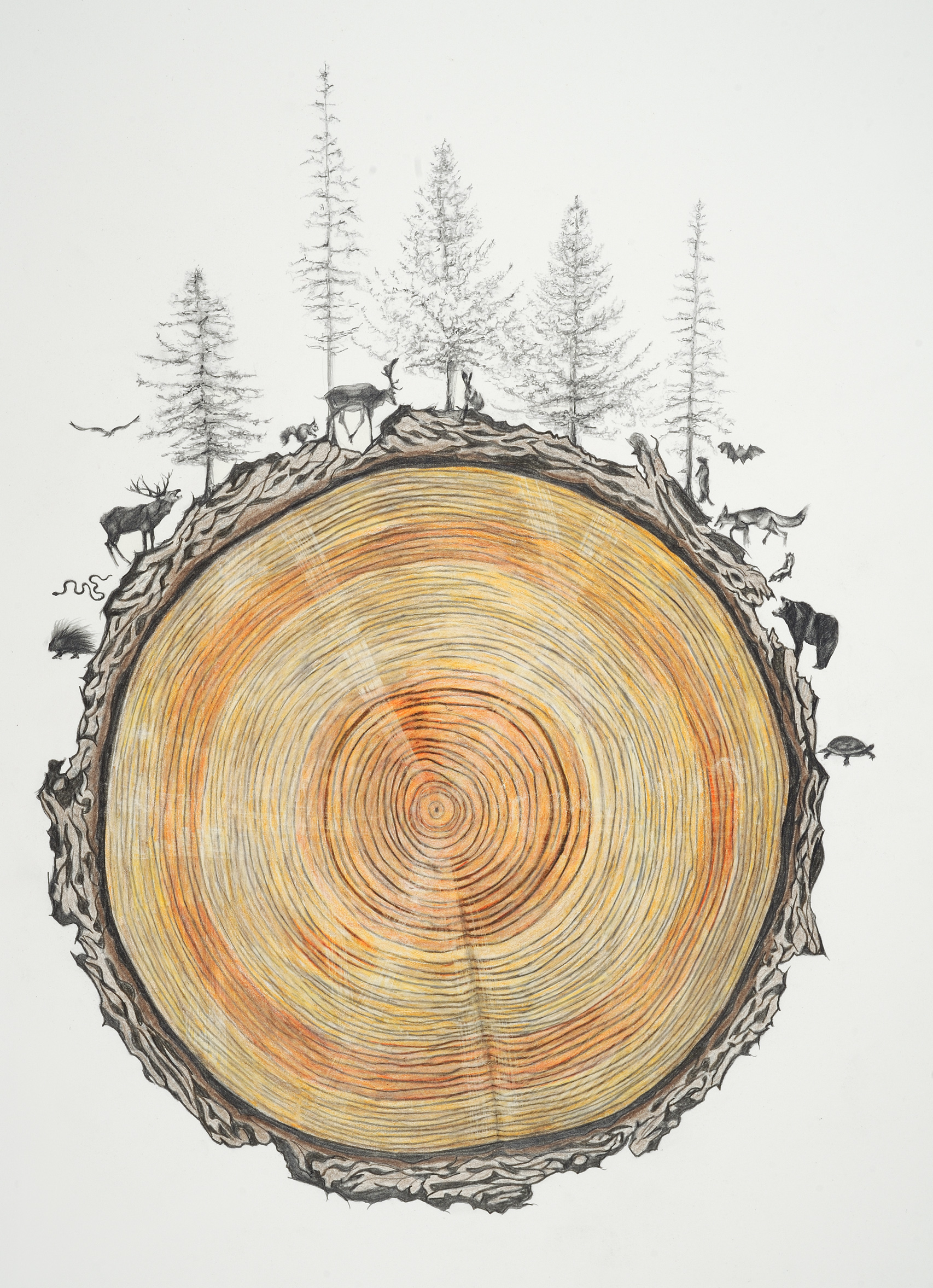
I was wandering through a small forest, being mindful to avoid the poison oak, when a yellow flash in the distance caught my attention. There I saw a small placard, affixed to an otherwise nondescript Apache pine. I had stumbled upon a bearing tree.

Bearing trees are a type of geographical marker that predates GPS and iPhone mapping, harkening back to a time when orientation was set by direct observation of physical place, not satellite cartography. They set a reference for surveying and development of the neighbouring land. And, surrounding this particular bearing tree, was a wide field of ragged stumps.
The bearing tree was a witness to this destruction, left lonely but safe by its yellow tag.
I wondered how it was chosen, this specific tree, to be a measure of things for that land. And the consequences of that choice. For once selected, the tree served to further extractive expansion into the wilderness. It would not be felled then, even as its neighbouring evergreens were razed for timber and commerce. The bearing tree was a witness to this destruction, left lonely but safe by its yellow tag.
The bearing tree had a boundary around itself, a surrounding wall containing one. In contrast, most walls, whether erected to defend ancient Spanish ports from piracy or laid out as a steel ribbon cleaving the United States apart from its southern neighbour, are a boundary of many. They create a division that separates ‘us’ from ‘them’. In The Book of Trespass: Crossing the Lines that Divide Us, author Nick Hayes observes that,
A wall is a technology of division. Its presence alone creates a simplistic binary logic that imposes the idea that one side is separate from the other, and moreover, that both sides are opposed to the other… Walls look like order, but more often than not a wall stands at the precise fulcrum of an imbalance in society. Most walls are only necessary as a means of defending the resources of those that have them from those that lack them. In this way, though they present themselves as mechanisms of security, they are in fact tools of oppression.
The Southern border wall fits this description well. Arguments are made, often in contrast to empirical evidence, that these north-travelling migrants ‘take American jobs’ and drain local economies. Such claims forget the nation’s history. Engraved on the pedestal of New York City’s Statue of Liberty is an inscription asking to receive ‘your tired, your poor, your huddled masses yearning to breathe free.’ Eighty six years ago, President Roosevelt reminded us to ‘remember always that all of us, you and I especially, are descended from immigrants and revolutionists.’ Yet right now over two hundred migrant bodies are discovered each year in the desolate sagebrush of Arizona. Many more deaths remain hidden, eventually turning to mere bones, blanched white by the relentless desert sun.
Boundaries are in fact essential for a healthy life. The stomata of a laurel tree open and close in sync with humidity and carbon dioxide levels. Mammals sweat, opening their pores to release heat and impurities. The moment when water changes from liquid to gas is a boundary full of coursing dynamic energy. Yet, these boundaries are animate, places of fluidity and instability. In contrast, a wall is Cartesian. Mechanical and rigid. When boundaries become fixed, whether for political or psychological reasons, they can easily transform into a wall.
I’ve spent much of my life near the border at one side or the other of my country. I grew up near East Los Angeles, driving down south regularly for cheap Tijuana penicillin and five-dollar lobster dinners in Puerto Nuevo. Now I am closer to el otro lado, living in Washington State and travelling regularly to visit my son three hours north in British Columbia. The limited porosity of the Douglas Peace Arch border crossing allows me to pass through fairly easily. But it denies so many others the same freedoms.
The foundational considerations are different between a wall of one, such as surrounds a bearing tree, and a wall affecting many. Who or what is included in ‘us’ or discarded as ‘them’ in this broader demarcation? Who makes the decision to repel the many others?
The United States border wall excludes both those humans not ‘passport approved’ as well as all of the more-than-human realms in its application. Animal migration paths are disrupted and habitat is destroyed. Jaguar, mountain lion, and Bighorn sheep communities are severed in two, reducing gene flow and narrowing genetic diversity. Artesian wells in Arizona’s San Bernadino National Wildlife Refuge have been destroyed, with mechanical pumping now installed to maintain sufficient water pressure for use by local wildlife. Protected saguaro cactus, sacred to the Tohono O’odham Nation, have been razed during wall construction, with invasive species then finding good purchase in the now disturbed soil.
In policy implementation, the U.S. Border Patrol has legal authority to waive environmental laws such as the Endangered Species Act and the National Environmental Policy Act to build the ‘infrastructure’ it deems necessary. These policies have real ‘here and now’ effects. In the summer of 2023, a fire in the Rio Grande Valley Wildlife Refuge trapped fleeing animals against the wall, burning them alive. This ‘infrastructure’, the border wall, is a disaster for local biomes.

After leaving the Cochise Stronghold last November, I drove down to Naco, a scrappy frontier town sliced in half by a thirty-foot-high border wall. I heard that local artists had painted murals on the Mexican side, splashing colour on what is otherwise a monotone copper cicatriz (scar), but I didn’t have my passport handy, so I didn’t cross la frontera to see for myself. Parking my rental car in a dusty lot a few feet from the blockade, I thought about the increasing political focus of this barricading wall, a separation of ‘American’ from ‘other.’ These arguments portray the fence as a dam of safety. But who is considered in that definition? Surely not the Sasabe mustang herd.
I saw a perfectly straight line that bisected the desert; a scar that cleaved one land in two.
As the day waned, I left Naco and travelled west up into Coronado National Monument, hoping to watch the sunset from its jagged peaks. Gazing east from Montezuma Pass, over Naco and beyond, I saw a perfectly straight line that bisected the desert; a scar that cleaved one land in two.
Our world is an animate one. A boundary that does not recognize this fact will not only fuel ever increasing polemical conflicts in the short term but will result in severe species and habitat loss over time, turning the free flow of populations across their historic range into a scarred landscape of loss. Such millennia old migrations don’t rely on GPS coordination. They develop from an intimate reciprocity and interbeing with the land and the other beings on that land. These interactions are themselves, according to author David Abram, ‘slow gestures of a living geology,’ a sort of planetary metabolism, and ‘one of the surest signs’ that the earth herself is alive. A blockade, the fixed rigidity of a wall, is an attempt at extirpation of that wider breathing and animacy.
I travelled back to that horse ranch in Sasabe a few years ago on a vacation with my husband. It’s under new owners now and when I asked around none of the ranch hands knew anything one way or another about local mustangs. I rode over some of the same trails that marked my stay fourteen years earlier, cantering westward along the metallic border wall and craning my neck to the left as we approached the pond I remembered from over a decade before. A slight breeze swayed the now much taller grasses. The water level seemed lower. There were no mustangs to be seen.
References
Abram, D. ‘Creaturely Migrations on a Breathing Planet’, Emergence Magazine, Volume 4, January 2023, p. 151
Hayes, N. The Book of Trespass: Crossing the Lines that Divide Us, Bloomsbury Publishing, November 2021, p. 95
Dark Mountain: Issue 26 – Dark Ocean
Our Autumn 2024 issue is a full-colour exploration of the world's oceans in an era of collapse – in narrative, verse, art and photography.
Read more