
‘What do you keep when the storm comes in, and the tide goes out?’ was a question posed by our twenty-second issue ARK. What do you hold dear in the library of your heart? Writer Neale Inglenook treasures the memory of a coastline he is forced to leave, and the house of the poet, Robinson Jeffers, where he had once been a scholar.
In many ways, this poignant farewell to a homeland encapsulates all the themes Dark Mountain makes space for amid the furious pace of civilisation: the rootedness of place, the lineage of writers, the beauty of wild nature, the karma of colonialism, climate disruption, grief. And also because it is a praise song for the writer whose work provided the foundations stone for the particular planetary frame of the project, and the inspiration for its name.
The main reason however I chose this piece by my fellow editor was for its tone. Tone is one of the hardest things to get right in a piece, as every editor knows, and much of this depends on its tempo, its relationship with time. There is a measure in music known as ‘sostenuto’ which means sustained, and is often used in slow and elegiac work. It is rare capacity in a writer to be able to sustain, not only a reader’s interest but an emotional depth, so that heart-breaking though the story is, you don’t move away.
Writing in the ghost footsteps of Jeffers, as he walks through the rooms for the last time, Neale remembers how the poet’s lines and the house he built had acted as granite anchor for ‘the real and the beautiful’ in his own life. Like a slow moment of a string quartet, interspersed with bright moments of children’s laughter, the sharpness of a gull’s wing, a glimpse of the vast eternity of the Pacific Ocean, he takes us full tilt into the existential territory of Dark Mountain, the awareness that we are, like the otter, ‘A little vessel of warm life in a cold sea’ and the writer is calling this to our fleet attention, lest we forget. (CDC)
The first day
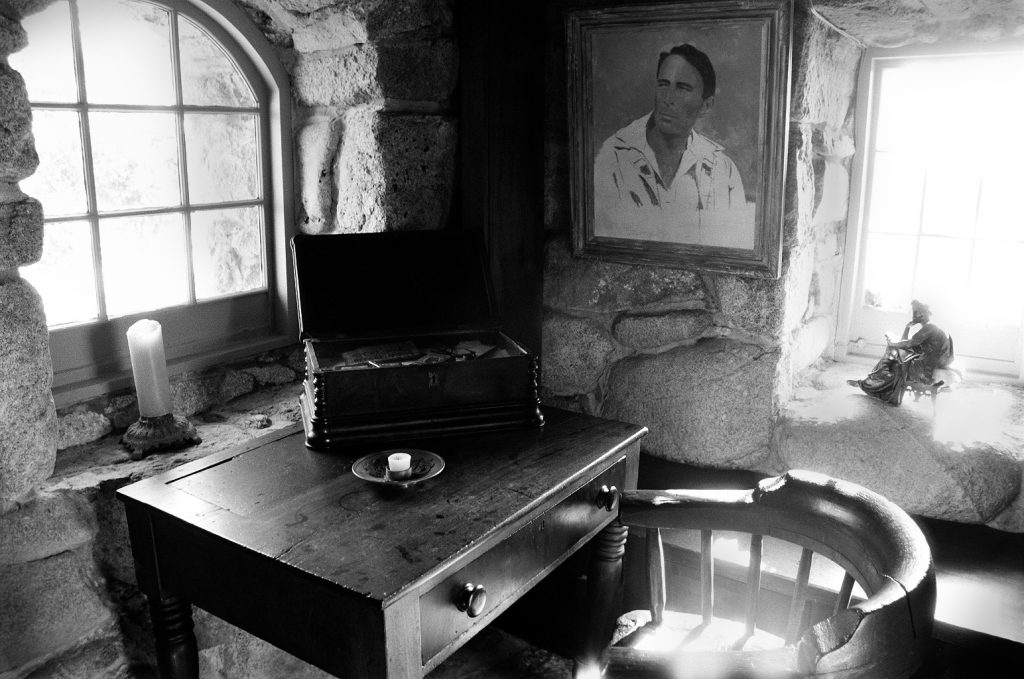
I sit enclosed in the lower room of the tower. Mantled in stone you dredged from the tideline in the cove where the boys played. These walls, castle-thick, mediaeval windows set back in their alcoves. Above me hangs the height and weight of your work. In the western window are pictured the waving leaves of irises, the tiny patch of grass, the sundial in the corner of the garden wall, and beyond, the horizon of the vast Pacific.
Here is your desk, marred by a long crack across its surface, cigarette burns, cup stains like crescent moons. Here a box holding your things: your razor, your folded glasses with their scratched lenses, your pipe, your pen. The razor rusts; everything is furred in the dust of decades. So intimate as to be banal, meaningless trash to almost everyone. These objects are imbued with your presence – looking at them I can almost feel your cheek against mine.
I place my hand on the desk, where your hand once rested. I open my notebook and begin to scritch out these words, addressed to you. Through the open door flows the restless sea wind, and the call of the gull, strident and wise.
*
I have come to sit with you, old spirit, on this windswept headland above the rearing surf, amidst the cypress and eucalyptus forest you planted, the granite stone you raised into house and tower. I’ve come to listen for you, as I do, though soon I will be gone from here.
You said: My ghost you needn’t look for; it is probably / Here, but a dark one, deep in the granite, not dancing on wind /With the mad wings and the day moon.1
Still, I’ve come. I know you are here – I feel you. Your fingerprints are impressed into the mortar between each stone.
This is what I’ve brought: wine, milk and honey. I carry them through the coast sage and planted rosemary to the cornerstone of the house. The rock you wrote to: A hundred years, two hundred, / You have been dissevered from humanity… no one / Touched you with love…2 Its roots go deep in the dark midden, riddled with shining abalone shell left by indigenous people – it underlies the room where you died. Like you, I pour the offerings into a crevice of the rock. A symbolic gift to the place, and also to you, who has gone down into the stone.
*
I didn’t know that I would need you. Similar in some ways in temperament, it is not strange that I would be drawn to your work. That little paperback of selected poetry, pieced together after your death, has made its way into any number of backpacks carried by wilderness sojourners like me. I’m sure it has been forgotten by most of the students in the class in which it was assigned, where I first heard your voice.
To me it was the sudden cry of a hawk in an empty sky. An exhortation to see the burning life in this wild coast.
And then my best friend died. Cancer. He was my age, twenty.
There are moments when the façade of civilisation is laid bare for the tawdry lie it is. When it is made clear how horrifically banal are all our daily concerns. When the curtain is pulled back, and behind the hackneyed scrim is a universe blazing in white-hot pain and ecstasy without respite.
There were no other words that spoke to the real then, all others were insulting in their smallness. Only you could speak to me.
You never lied to me. I may have walked about as though the skin was flayed off my back, that raw, but you never gave me platitudes, never denied the pain. You said, pain can shine.3 You said, this coast crying out for tragedy like all beautiful places.4 You said, experience and ecstasy.5
*
There were bright beautiful things in those years, my first writing finding an audience, my first fire springing to life from the bow drill friction, long difficult climbs among the spires of the high mountains. A marriage.
And tragedies: a colleague killed his best friend and himself. A childhood friend fell from a cliff above the sea. My wife’s father fell into a ravine in this coast range. My last grandparent was debilitated by a stroke. My uncle crashed his truck into an orange grove. My marriage burnt out like a flaming star.
Always here was your house, where I could come to feel in contact with the real and beautiful. Where I could hear your potent words as if emanating from the stone. It’s two decades since that inaugural loss, and now this tragedy: I must leave this land and sea that I love. I must leave your house.
*
The onshore wind has whipped up white caps on Carmel Bay. Across that water, Point Lobos is a dark prow aimed into the smoking breakers.
I go into the house, sit on the bench beside Una’s piano. A light poise, for all the weight of this granite and dark wood. The shush and thunder of the breakers is gentled by the thickness of the walls. The motes slowly eddy in the westering sun where I have passed.
In the lowering light the water becomes undulant slate, the stones of the tower and the shore are painted with the tones of their early fire. Watching the flaming sun colouring the spume of the waves, the gulls soaring to their roost, your cypress grown tall and their limbs breathing the wind off the sea, I am that much closer to bridging the gap between us.

The second day
The ocean today is titanic and cold – towering swells caping the jagged coast rocks.
Inside, the house holds a perpetual chill, no fire in the hearth in decades. The stones returning to the inner cool of the tideline. I feel the staid museum quality, the awkwardness of a domestic space unlived in. The fireplace in the kitchen smells of mice, the living room of musty cloth. Dust in the still corners.
All these years I have been taking in your poetry, so embedded in the shape of this house – this place feels familiar enough to be my own home. I am trying to give back to it, leaving the blood-heat of my body as I move through the rooms and touch the stone, put down these words.
In return, I will carry away with me your words, which have worked into me, a shuttle of pain weaving them into the fabric of my being. I will carry away the tactile sense of this house, its rough stone and smooth wood, its windows looking down to the shining shore.
*
At sunset I go around the point to the mouth of the Carmel River, the white beach sloping steeply to the tourmaline waves tearing at the sand.
Geese and pelicans float in the lagoon, their bills tucked against their breasts for sleep. Everything is both dim and incandescent as though lit from within. The ocean water has turned to mercury. Then the full moon rises in the throat of the valley, a gold coin in the velvet of the night.
The third day
I climb the steps of your tower, and as I come to the last set of stairs and grasp the rusted chain, I look out and am awestruck by the cobalt immensity stretching to its meeting with the sky. My guts seize, my hackles rise, I have to look away. No gazing idly at this ocean without proper preparation. Great Pacific, who transcends half the world, eats continents, holds the Earth’s greatest mountains in your womb, who is the very abyss. Beautiful and terrible, powerful beyond reckoning, your least wave could obliterate me.
Shivering on the apex of the tower, I am calmed to watch the gulls ride the buffeting wind. The pelicans skimming the breakwater as though they were held apart by magnetism. And the otter, afloat on her back in the troughs of the rolling breakers, seemingly so at ease, the water in turmoil around her. A little vessel of warm life riding that cold sea.
I see you, Jeffers, constantly overwhelmed by this monstrous ocean, channelling it by force of will into your poetry. You refused to look away, a mystic staring into the sun.
I see you, Jeffers, constantly overwhelmed by this monstrous ocean, channelling it by force of will into your poetry. You refused to look away, a mystic staring into the sun. Even still, the solidity of the house and the tower are a defence against the terrible beauty. There must be some refuge.
The stones of the tower are rough, their crystal grain standing in relief. They rasp my clothes as I climb the steps. Some even keep the barnacles from their tideline origin. Like you, the house and tower have a rough-hewn exterior, guarding a tenderness within, small gestures of welcome, even the whimsy of childhood. The secret passage within the wall that leads to the second storey, emerging from behind a wall panel. The wood finished to a mild smoothness, the low benches banked with cushions, the little windows allowing only so much of the outer world to enter.
Your ashes were spread with Una’s in the garden – your body has become this place. It is as you said: I wander in the air /… and flow in the ocean… / have a hand in the sunrises / And the glow of this grass.6 But even more potently, you and your work are one with the house and the tower. Working at your desk, I sit within you. Climbing to the height, I look upon the coast with your eyes.
*
Today I am deep in the tiring work of grief. My time here is wearing away like the crumbling headland, turned to sand and carried off by the relentless waves. I have only a few hours left here, in your house, and indeed in the whole of this landscape from which I grew.
I find myself trying to store up images and sensations, as though packing the ark of my mind: the feel of your tower’s stone under my palm; the sight of the wide ocean reflecting the sky, the deepest blue I have ever seen; the scent of sweet alyssum in the sun; the perfect white wing of the gull.
Everything so potent I can hardly take it in – like a lightning rod for feeling, here on the height of the tower.

The fourth day
The wind is cold out of the north and the sky is blank grey cloud to the sharp horizon. In the garden, cottontails nibble at the grass, ears quivering, their bodies thrumming with sensation, while they do the steady work of living. The flowers are lambent in the low light.
Later, Ash will bring our daughters to visit. Like the gulls and otters, seals and cormorants, our children are immersed in their experience as if in the ocean waves. Their enthusiasms and joys, their fears, angers, disappointments, all glow bright in them, the heat of their lives near the surface. I think their voices in the tower, their footfalls in the secret passage, will add something back for which the space was made and for which it yearns.
*
Not long ago, fire raged in our hills. Sky like dim flame, ash falling upon the wilting garden. Our daughters hammering the windows, not understanding we kept them inside to save their vulnerable lungs. These things we do in the name of love.
The centuries-long inertia of extractivism and colonialism is burning this place. It began with the missionaries, who arrived here with their dogmas and enslaved the people of this coast. Their mission is preserved just around the point from your house. Hard on their heels, Euro-Americans engorged with manifest destiny and ravenous for gold, carrying their murderous guns. The people that lived here pushed to the periphery of what the settlers claimed. The redwoods clear-cut to the last few old-growth trees, the California grizzly extinct though it waves on the state’s flag. Otters and condors nearly lost, whales and sardines all but gone. The straight lines of the strawberry fields in the silted river valley, the sick machine-mind of the plantation.
You said, mind like a many-bladed machine, subduing the world with deep indifference… 7
You saw it clear, but you also benefited from this. It allowed your house to be built on sacred ground, inhabited for millennia. Native people still live in this area – they are not gone. They have been disallowed from this place through violence. That you felt the pain of the spirits here, saw their dim forms on the shore, is only small consolation.
I also have benefited from this bloodletting, my whole life spent walking upon stolen land. And now the opportunity to be in this place and love it is stolen from me and Ash and our children in turn, the brutal irony of colonialism. Its price will be extracted, from whomever it can.
It is bitter medicine, but I have often thought of your poem, wherein wildfire swept over the coast range, and in that blackened landscape an eagle came to feed on the animals that did not escape.
And you said: I thought, painfully, but the whole mind / The destruction that brings an eagle from heaven is better than mercy.8
Hard to swallow. It is in these moments of pain that I hate you a little.
But this pain can be endured. Indeed it is my duty. To endure the pain and change our life so that we might take less. The fire forces us from our home, to make the necessary change, to alight like windblown seed, somewhere we might flourish – this is better than mercy.

The last day
A late rain in this dry spring came last night. The clouds cloak the west in depthless grey, all distance obscured. But from here beside your house, Point Lobos is stark granite dressed in white spume, dark cypress rising up its flanks. The beauty of the world stands unabashedly naked. The passion of the aeons of rock and the ceaseless waves, the deathless wind the pelicans ride.
Sitting here for a moment, after all the preparations for leaving, I pause and listen for you – and the loss comes and sits heavy in me. It is like an approaching death, though who or what is dying I can’t quite say. You are dead now and your ashes in the garden sixty years. And you are here with me, in your chair, my hand where yours was, penning words at your desk.
I am losing the particular scent of this sea wind, briny, stony, cold, carrying battered wings of kelp and the sharp tang of cypress leaves, the sturdy headland flowers enduring to blossom
What I am losing: bodily contact with these stones that hold your spirit, that stand in the walls of the house and rear on this coast to battle the sea. I am losing the particular scent of this sea wind, briny, stony, cold, carrying battered wings of kelp and the sharp tang of cypress leaves, the sturdy headland flowers enduring to blossom. I am losing the brilliant flash of a hummingbird feeding in the dry rosemary, the other side of the wall from your deathbed.
This is an intimation of what it is like to let go of this life, to depart into another form. This body parted from this place that made it, my roots torn up. Separated like parent and child, the ongoing process of release.
*
Afternoon. Storm light, clouds ready to rain. I sit at your accustomed place in the bay window, drink my quotidian coffee. But walking in here, a shadow in the window pane of the dining room door snagged in the corner of my eye – some dark, still figure.
Was it my reflection? But no. I am certain in my bones you are here.
I wonder if you have heard me, bumping around in your spaces, breathing your air, sitting at your table or your desk, speaking silently to you through these words I put down. I wonder if you’ve risen out of the granite on this clouded day, perhaps to meet me at last.
*
I sit in your chair one last time. There will always be an ache at this separation, a part of me cut away – it can be borne. This land and sea will be here, weathering the onslaught of the future. Meanwhile, the image of the pristine beauty / Lives in the very grain of the granite, / Safe as the endless ocean that climbs our cliff.9
Before I left home this morning, our oldest daughter gave me a cornflower she’d picked – an almost impossible purple-blue – and told me it was to remind me of her. Looking at it now, the feeling it evokes is so intense as to be painful, as though all my organs are bruised. This simple beautiful thing, the gift of a picked flower from an earnest child. It is almost all we should hope for.
I will leave it with you, this flower, this feeling. An offering, a libation for the spirit, my farewell.
All photographs by Robin V Robinson
Images from in-camera film negatives
Tor House in Carmel, California, hand built by Robinson Jeffers, holds a damp and thick feeling between its rock walls. It is well protected from the wild sea and the modern homes built over the last one hundred years around its borders. One can tour the house and sense the spirits of Jeffers and his family, their energies still living in the 21st century, never leaving this place. Photographing Tor House and its small spaces sparked my growing interest in the lives of poets. What truths haunted them? The photographs reveal the feelings of the living quarters and writing spaces where they received and expressed those messages so heartfully.
Robin V. Robinson is a Carmel, California, artist who is curious about the way we see and experience the planet and ourselves. Her ideas explore perspective, time and consciousness. Her latest work includes a photographic series inspired by the poet Dylan Thomas. Robinson was trained in the West Coast photographic darkroom tradition and remains analogue. Her work is included in museum and private collections. robinrobinson.com
Dark Mountain: Issue 22 – ARK
Our full-colour Autumn 2022 edition is an ARK carrying a cargo of testimonies, stories and artwork gleaned after the flood.
Read more
References
1. Jeffers, Robinson. ‘Tor House’, The Selected Poetry of Robinson Jeffers, edited by Tim Hunt, Stanford University Press, 2001, p. 181
2. ‘To the Rock That Will Be a Cornerstone of the House’, ibid. p. 21
3. ‘Contemplation of the Sword’, ibid. p. 527
4. ‘Apology for Bad Dreams’, ibid. p. 141
5. from ‘At the Birth of an Age’ (vision of a self-hanged God), ibid. pp. 506–507
6. ‘Inscription for a Gravestone’, ibid. p. 372
7. ‘Meditation on Saviors’, ibid. pp. 172–177
8. ‘Fire on the Hills’, ibid. pp. 394–395
9. ‘ Carmel Point’, ibid. p. 676


Neale Inglenook and Dark Mountain: I was introduced to Robinson Jeffers’ poetry by a little paperback. “The beaks of eagles” sentiment felt like home to me. Nature changing with the changes, mankind doing what he must.
From Cambria the road that led to the Step Ladder ranch, left at a sudden juncture winding up a deeply rutted path, l was greeted with snake skulls and plastic doll heads adorning the fence posts and a gate sign that said, ” If you don’t belong here turn back.” A new friend lived in a half A -frame house there. Near Tor house.
I would go for walks and saw worn broken chimneys, a past long forgotten. The sun-shining on grass tall or wind blown. This is my heart-felt memory that I make real now.